Friday, March 19, 2010

Family Trees

The mission:

Play as many of the 80s games as you can and consider:

* The evolution of the basic elements that you looked at last week

* Describe a favorite 80s work in terms of the evolving design features discussed in the lecture (Genre, World, Narrative, Graphics and Perspective)

* Find a descendant (literal / emotional) and compare

* Particularly consider how many of the core mechanics have evolved in conjunction with improved graphic capabilities – compare with some contemporary games


The last post was about the evolution of narrative and whether it is a background element or an integral part of the game. There are still many games where the story adds background flavour, you can replace the main character and other elements without disrupting the story.

Games like Super Mario or Sonic could have different characters without affecting the story line or way you play. Castlevania(1986) or Metroid(1986) could almost be the same game if the narrative did not dictate what the game world was.


Top: Castelvania (1986)
Bottom: Metroid (1986)


Both games offer similar gameplay, you must explore the environment, defeat bosses and find items or abilities to progress deeper in the environment. The fact that one is a gothic fantasy and the other set in space could be overlooked but the narrative enriches game play.

Let's take a closer look at the Castlevania and Metroid Series.

Genre:
The 1st Castlevania and Metroid games were released in 1986 and are classed as action-adventure games with platform elements. Unlike Castlevania, Metroid doesn't feature distinct levels, instead the game world is connected via doors and elevators. Castlevania would adopt this approach in 1997 instead of the linear stage it had previously used.

Both games would also feature a character with a changing arsenal of weapons. This would change how the players took on obstacles(enemies). Instead of jumping on the enemies, the player would need to think more tactically, eg. Time their attacks or movement, weapon choice etc.


Top: Castelvania: Symphony of the Night (1997)
Bottom: Metroid (1986)


World and Narrative:
The worlds and narratives of Castlevania and Metroid form a symbiotic relationship. They could work without each other but the game experience would be lacking. Both the main characters need a goal to complete but also creates an opportunity to create an expanded world.

A larger world means the player will spend more time in the game which gives rise to the many sequels or related games from the series. The story of Metroid is grown in each installment, Samus is constantly fighting against aliens that are from another planet or produced by human organisations. Space travel provides a convenient method of creating different areas and using these environments to provide enough challenges in the game to make it enjoyable or difficult.


Top: Metroid map
Bottom: Castlevania map(1986)


In Castlevania, the ever present threat of Dracula's revival fuels the narrative of the series. In later games the narrative becomes more complex as different characters fight to prevent Dracula's resurrection which is heralded by the appearance of his castle. The castle then becomes the game world in which the player explores and experiences the game.

Graphics and Perspective:

You can look up the specs of the Nintendo Entertainment System on the Internet. A pull from the internet monkey gives us this on the graphic capabilities of the Nes.


The system has an available color palette of 48 colors and 5 grays. Red, green and blue can be individually darkened at specific screen regions using carefully timed code. Up to 24 colors may be used on one scan line: a background color, four sets of three tile colors and four sets of three sprite colors. This total does not include color de-emphasis.

A total of 64 sprites may be displayed onscreen at a given time without reloading sprites mid-screen. Sprites may be either 8 pixels by 8 pixels, or 8 pixels by 16 pixels, although the choice must be made globally and it affects all sprites. Up to eight sprites may be present on one scanline, using a flag to indicate when additional sprites are to be dropped. This flag allows the software to rotate sprite priorities, increasing maximum amount of sprites, but typically causing flicker.


Obviously the 1986 Castlevania and Metroid are pretty much pixel pancakes. They're flat and don't come in many colours. Even with a limited colour palette, the games were still able to deliver a believable game world if you just squint with your mind.


The graphic and technological capabilities of the era made 2D the easiest option. We're only offered a side view of our character, any sense of perspective is flattened. The game space has only 2 layers, the moving background and everything else that the player can interact with.

Moving ahead in time and the use of 3D, the graphics and perspective change. Being able to move and see in three dimensions means that the environments should be follow realistic perspective. As stated before, a bigger narrative means a bigger world and vice versa.
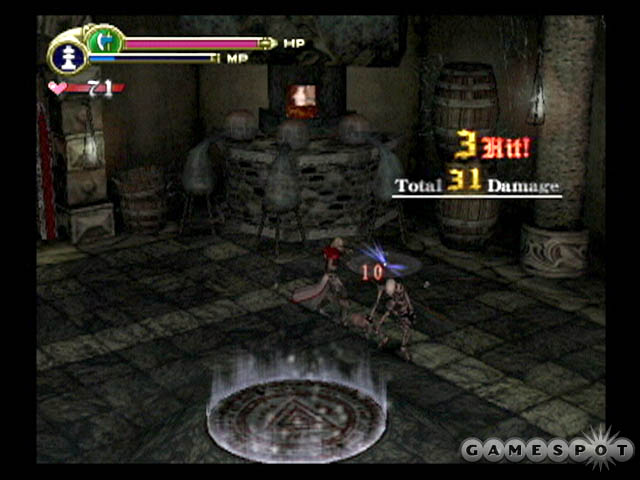


Top: Castelvania: Lament of Innocence (2003)
Bottom: Metroid Prime 3: Corruption (2007)


With better graphics the action becomes more realistic (within reason, if you're sporting a cartoon style you can play with reality). The 3D player has to be able to turn around and see the world or whatever hideous creature is about to come at them. Gameplay is more intense now that you have a (fairly) realistic world to explore.

Core Mechanics & Evolution:

In both Castlevania and Metroid, the core mechanics are:

- A player character that can move in 3 directions and jump
- A player character that can attack and has subweapons
- An explorable map/world that scrolls

Castlevania also offers:
- Stages that must be cleared
- Sub weapons that have different effects
- Whip that can be upgraded

Metroid has:
- One big world connected by doors and other passages
- Samus has upgradable weapons and abilites
- Some areas need certain abilites to be reached

During the later games, a lot of these mechanics are enhanced or changed. The whip in subsequent Castlevania games becomes a tool for reaching other areas. Samus' abilites change depending on the game environment, locking onto an enemy becomes possible in the 3D games.

The core mechanics of a game have to change to keep up with the changing complexity of the environments. When technology progresses more, the audience will expect the game to be capable of much more.

A Marriage - Narrative and Mechanics

This post is all about answering the question: Is the narrative part of the gameplay or is it merely an introduction to set the scene or wallpaper? Please note the use of narrative is from early games such as Donkey Kong, Pac-Man and Asteroids.

Nara-wha?:


A question, is there a story to the game Pac-Man? Yes or No? A game like Pac-Man has no discernible story, instead it is all about the "chase" and eating. What about Pitfall!? Harry has a name but not much else that makes him stand out from a stick man. There is no actual narrative in this game either but that wouldn't stop a player from creating one for the game.


There aren't many clues in the game, Harry could be anyone but why is he in the jungle and why must he get out so quickly? If you create your own narrative, doesn't it make Harry's adventure more rewarding? A player can become more involved in the game, it is no longer a demonstration of skill, it is a quest.


You could say the same for Asteroids and Space Invaders. The game mechanics and play gives you no indication as to why saving your space ship or the world is important. They are all tests of survival.


Courtship:

In 1981, Donkey Kong was the 1st game to use complete narrative in a game. The typical damsel in distress story combined with challenging gameplay. Does this narrative just an excuse for play or is it part of the game?


In Donkey Kong you're given a clear story which outlines the goal of the game. Save the girl. It is a little hard to dissect the gameplay from the narrative and vice versa. Both co-exist but it can also be argued that one is supporting the other.

Haunted House offers a different side to the argument. The game's story gives you a reason for playing this game but without it the player would be clueless of their goal.


There are not enough visual clues in this screen shot to show what is the goal of this game. Which of these icons represents the player? If you weren't familiar with this game, you would not know that it was the pair of eyes.


Rags to Riches is a game about a homeless man who decides that he is going to work his way up the social ladder. The catch is, the player is the homeless man. Although there is no narrative, the player has to connect with this character and the world.

The game provides real life obstacles, the man must get a haircut if he wishes to seek employment but must also dodge the police, robbers and the IRS. This game gives the opportunity for the player to create a story for the character but one that is in the confines of the world.

Although there is a long term goal, the "story" is obviously a way to set the scene for the game. Sadly, if you do reach the goal of becoming a millionare, there is no ending. The game will still continue to play the game of life.

Case Studies:


Bentley Bear finds himself in a castle filled with monsters and witch who are out to get him so he won't walk away with large amounts of the witch's treasure. The plot of Crystal Castles provides you with background for the game. It is one of the few games that features a definite ending instead of repeating the game on a higher difficulty level.

What is the core mechanic and what genre would you call the game?

The player has to find the best way to move Bentley around the screen to collect gems and avoid enemies. Bentley also has the ability to jump on and over enemies.

Crystal Castle is a platformer with some puzzle game elements, you need to complete the level quickly but you also need to move in the environment that allows you to maxinmise your chances of survival.

Does it matter that Bentley is a bear?
Bentley the Bear provides a basis for themeing designs of collectables it doesn't really add anything to the story. You could replace the bear with just about anything from a frog to a robot without harming the story.


Consider The Legend of Zelda (1986) – does it matter that Link is a young boy? What mythos does this game call on?

The Legend of Zelda and its subsequent children showcase how a narrative intergrates into gameplay. Link's goal is to save the princess but there is also the bigger goal of saving Hyrule from Ganon.

Playing as a young boy(man in some games) helps keep the sense of high adventure prevelant in the series. The youth who is exploring unknown lands echoes the player's exploration of the game world. When Link accquires new skills and items, the player can use these to track their own progression.

Link is an archetypal hero who can be found in different forms and media. From fairytales to comic books, the hero has many forms. Joseph Cambell's book The Hero with a Thousand Faces illustrates the journey of the hero.


Looking at the diagram, you can make connections to the flow of typical RPG games.

Obviously as technology progresses, the need for more involvement from the player into the game and world grows. There is a growing number of games that focus on the narrative and use the games as a means of telling that story.

On the flipside there are still games that use the narrative as a frame for launching their game. Having a narrative enables the player(s) to participate at a deeper level, making the game more enjoyable or at the least more interactive.

Thursday, March 18, 2010

Text Adventure - Finding a torch

I'm still drafting the essay in my head and on the computer so here's where it stands at the moment. This is rough and rambling so nothing will make much sense, this post is another launching point.

Main point - Star Wars is cultural phenomena

Arguments:

It is cultural icon
Star Wars is one, it has pervaded the world like a virus. There are generations who have not seen the films and yet still have a vague understanding of scenarios, quotes and characters. The influences of this series can still be felt today.

Considered to be responsible the "Hollywood blockbuster effect"
Jaws and Star Wars: A New Hope are considered to be the movies that made the "summer movie blockbuster" a ritual. These type of film is associated with fast-paced action and a "thrill factor" that made repeat viewings enjoyable.

Set standard for movie franchises
Rule of threes? A double edged sword topic where hearsay is rampant. Given the number of film franchises and trilogies... who knows. Star Wars did prove that trilogies could be successful and marketable.

Has huge fan base
I will be mentioning this but not writing in great detail about how influential this is.

Use of computer generated graphics
In the 1970s, Star Wars presented an innovation in using computer generated special effects for the first film. Lucas' need for cutting edge visual effects spawned the genus for Industrial Light & Magic but also inspired geeks to do more with their computers.

Wednesday, March 17, 2010

Episode VI - What's my line?

Here's a bunch of quotes on the cultural impact of Star Wars.

Emerson, J n.d:
"For 22 years, between the release of the original "Star Wars" film ("Episode IV: A New Hope") and the release of the first prequel ("Episode I: The Phantom Menace"), the "Star Wars" phenomenon had an impact on American popular culture like nothing else before, or since."

"The "Star Wars" phenomenon wasn't really so much about "content," though. It was more about capturing zeitgeist-lightning (or hyperspace star fields) in a bottle."

Hunter, S in Brown, J 2009:
"And that moment, I think, it's just one of the most treasured moments I have in a life of movie going. I mean, it promised so much, it was so romantic, it was so revitalizing, it was so much a sense of reinventing the genre, that it's a very powerful emotional moment."

"Well, for better or for worse, it spawned a host of imitators. Not imitators in the sense that they -- I'm not talking about cheesy imitations or parodies, but what it did was it made -- it sort of made the summer movie blockbuster. "

Pollock, T in Caro, R 2005:
"These are coming into a vastly different cultural world," Pollock said. "That not only includes the `Star Wars' movies but so many other large, long trilogies, Asian movies, epic movies. . . . Did `Lord of the Rings' have the impact that `Star Wars' had? No -- not because it isn't as good. I loved it dearly. But it came into a world where `Star Wars' existed and so many other things too."

Bach, S in Rickey, C 2005:
"Star Wars' transformed Hollywood from a moviemaking town into a synergized marketing town,"

Shyamalan, MN in Rickey, C 2005:
"He created a religion," says Shyamalan. "No other filmmaker has ever done that."

Ealy, C 1999:
"...they're trying to understand the cultural significance of the Star Wars saga, and in turn, discover clues about how a story captures the imagination of a society. It's too easy to dismiss Star Wars as unworthy of critical attention, they say. It's quite another matter to attempt to understand its resonance."

Biskard, P in Ealy, C 1999:
"Star Wars legitimized comic-book movies, where the endings are happy. It took serial formulas, B-movie formulas of the 1930s, and used modern technology to pump up those formulas and reinvent them. I call it the gentrification of the B movie. . . . It paved the way for the blockbuster syndrome of the '80s."

Jenkins, H 2005:
"The rich narrative universe of the Star Wars saga provided countless images, icons, and artifacts that could be reproduced in a wide variety of forms and sold to diverse groups of consumers."

"The action figures provided this generation with some of their earliest avatars, encouraging them to assume the role of a Jedi Knight or an intergalactic bounty hunter, enabling them to physically manipulate the characters and props in order to construct their own stories."

Lucas, G in Sibley 2007:
The success of the Star Wars series would not be possible if it did not possess an abiding cultural resonance. After the release of The Empire Strikes Back in 1980, Mr. Lucas told an interviewer that "this is the kind of movie we need. There needs to be a kind of film that expresses the mythological realities of life -- the deeper psychological movements of the way we conduct our lives."

References:

Brown, J 2005, The impact of the Star Wars trilogy, viewed 10th March 2010,
http://www.pbs.org/newshour/bb/entertainment/jan-june05/star_wars_5-19.html .

Caro, M 2005, The power of the dark side, viewed 10th March 2010,
http://www.chicagotribune.com/chi-0505080390may08,0,5154795.story?page=1.

Ealy, C 1999, Understanding Star Wars, viewed 10th March 2010,
http://delrio.dcccd.edu/mhenry/UnderstandingStarWars.htm.

Emerson, J n.d, How Star Wars Shook the World, viewed 10th March 2010,
http://movies.msn.com/movies/starwars/?GT1=7701&.

Jenkins, H 2005, Quentin Tarantino's Star Wars?: Digital Cinema, Media Convergence, and Participatory Culture, viewed 12th March 2010,
http://web.mit.edu/cms/People/henry3/starwars.html.

Rickey, C 2005, Debate brews about cultural impact of 'Star Wars', viewed 10th March 2010,
http://media.www.the-telescope.com/media/storage/paper749/news/2005/05/09/StarWars/Debate.Brews.About.Cultural.Impact.Of.star.Wars-953413.shtml.

Sibley, R 2007, How George Lucas created a cultural force, viewed 17th March 2010,
http://www.canada.com/ottawacitizen/news/story.html?id=c782db39-0f36-4ad1-bdf2-27a115ecb422

Sunday, March 14, 2010

Text Adventure - You wake up...

I'm planning the flow of the essay while still trying to research. Don't do it that way, it is fraught with perils and distractions.

My initial plan for the essay was:

Intro:
Map out where essay is headed and briefly state what each segment is about.

Star Wars and Video Games:
Write about which games have claimed direct influence from Star Wars and which could have had some influence from the work. I would also look at the Star Wars gaming franchise as well.

Archetypes and the Quest:
This section would look at the archetypes in Lucas' work and compare and contrast it with video games.

The Blockbuster Effect:
Since the release of Episode IV, Star Wars is considered to be the model for movie franchise. Here I would write about how the blockbuster influenced the video game industry.

Conclusion:
Rinse and repeat cycle, it's a summary of all the points on why Star Wars and Lucas are influential to the video game industry.

The main problem with this outline is that there are too many points to cover in 800 words. I'm thinking of compressing into 2 sections, Video Games and The Blockbuster Effect seem the easiest in terms of substantial evidence and access.

I'd love to do Archetypes and the Quest but I think all the evidence would be circumstantial at best. It's a little fantastic to try and prove that the Master Sword is indeed the Zelda analog of a lightsaber.

Saturday, March 13, 2010

Episode V - Dominating the Pixels

Let's take a look at the published Star Wars gaming commodities. Currently there are approximately 138 games with the brand name.

Starting from the 1982 Atari 2600's The Empire Strikes Back, the Empire has spread from console to console, PC and even mobile phones. Where does the Star Wars and video gaming relationship begin? Let's start at the beginning and what came before.

This is not a definitive list, it is a retrospective of games that have similar themes/style to Star Wars.

1960s

  • Spacewar!: Pitted two spaceships against each other while trying to combat the gravity well of a star.

  • Space Travel: A player operated ship would attempt to land on various planets and other space bodies.

  • Lunar Lander: A early text based game that also went under the names of Rocket, Lunar, LEM and Apollo.


1970s

  • Computer Space: Considered one of the world's first commercial coin-operated machine, this had you avoiding and returning fire from a pair of flying saucers.

  • Star Trek: A text game adventure where the player took command of the Enterprise and destroyed Klingon ships.

  • Space Attack & Space Battle: Due to a licensing hitch, these Battlestar Galactica games are a tiny dot in the Galactica franchise.

  • Space Invaders: Defend the world from aliens in one of the world's popular game.

  • Asteroids: Clear space of asteroids and pesky aliens in this famous game.

  • Star Fire: Heavily inspired from Star Wars, this game came with innovations like lock on, sit-down cock pit and allowed the player to enter their initials in the high score.

  • Star Raiders: A game that inspired the X-Wing series of the Star Wars franchise, it featured FP view in '3D' space and hyper space travelling.


Above: Biggs in the X-Wing cockpit
Below: Cover art for the video game Epic, look familiar?

Left: Cover art for Star Fire
Middle and Right: Ships from the Star Wars movies

During the early 80's, a toy company called Parker Brothers convinced Lucasfilms to let them produce games based on Star Wars for any platform. Quickly getting together a small team of operatives, the team set out to reverse engineer the Atari VCS and produce the first Star Wars game.

In general, the Atari[VCS] was so limited that we weren't so grandiose to say: 'Oh, we're going to recreate the experience of the move here'. It was clearly going to be a limited experience, something at best would remind you of the movie, evoke a little bit of the emotion and most importantly be a fun game to play. (Bradford, B in Edge, 2009)

Fun doesn't describe the results, over a million copies were sold and Parker Brothers would go on to make three more titled games. The Empire Strikes Back would prepare the world for the mass of Star Wars games that would arrive during the 80s and resurge in the new millennia.

One of the strangest video games to claim influence from Star Wars is Jeff Minter's Attack of the Mutant Camels.


Top: The Empire Strikes Back
Below: Attack of the Mutant Camels

“Normal camels aren’t that big, and so if they weren’t to be robot camels then they must be mutant camels. And thus was born a very silly game sequence indeed.” (Minter, J in Edge 2009)

Drawing inspiration from a review of the Parker Brothers' game, Minter created an imaginative experience which pitted the player against shielded camels that could fire lasers. With an aesthetic borrowed from The Empire Strikes Back, Minter's game could be seen as a parody but also as a retelling of the original game. The strangeness continued when Minter produced a sequel where the player assumes the role of a mutant camel flying its captors and evading the space ship from the original game.

Henry Jenkins(2005) writes that creative rewriting of science fiction, movies and television are now considered acceptable in main stream culture. With this in mind, the creation of Star Fire is not a subject of copyright infringement but a work of appreciation.

The industry increasingly refers to Star Trek or Star Wars as "franchises," using a term that makes clear the commercial stakes in these transactions. This new "franchise" system actively encourages viewers to pursue their interests in media content across various transmission channels, to be alert to the potential for new experiences offered by these various tie-ins.(Jenkins, H 2005)

When nascent technologies become more readily available, publishers and promoters are able to provide extensions of popular narrative to its fans. (Jenkins, H 2005) Star Fire places the player in a virtual cockpit of a spaceship which is modelled heavily off the x-wing fighters from Star Wars. Star Wars as a cultural phenomena seems to incite a desire to recreate the experiences in the movies.

In 1977, the movie "Star Wars" came out, and Ted(Michon) thought it was the best movie ever, and he wanted to develop a game in this genre... Ted and his wife prepared the graphics, which had a "Star Wars" look to them. He figured that either we would license the rights or we would make whatever changes were necessary to avoid legal infringements... So the succinct answer to your question is that Exidy had very little input into the game play, and Ted was responsible for the Star Wars look. (Rolfe, D in Good Deal Games 2006)

From this, one could argue that several of the x number of space games have been attempts to emulate the experience of Luke Skywalker and Rebel Army to reclaim their piece of the universe from the hand of the evil Empire.

References:

Backwards Compatible - Star Wars 2008, Good Game, ABC1, 28 September 2008.

Edge Magazine 2009, The Making Of:Attack of The Mutant Camels
http://www.edge-online.com/magazine/the-making-of-attack-of-the-mutant-camels.

Edge Magazine 2009, 'The Making Of... Star Wars: The Empire Strikes Back', Edge Magazine, col 209, pp. 112 - 115.

Gametrailers.com 2008, The Star Wars Retrospective Episode I, viewed 13th March 2010, http://www.gametrailers.com/video/episode-i-star-wars/31944.

Good Deal Games 2006, Interview with David Rolfe
http://www.gooddealgames.com/interviews/int_rolfe.html.

Jenkins, H 2005, Quentin Tarantino's Star Wars?: Digital Cinema, Media Convergence, and Participatory Culture, viewed 12th March 2010,
http://web.mit.edu/cms/People/henry3/starwars.html.

'History of Video Games', Wikipedia, viewed 5th March 2010,
http://en.wikipedia.org/wiki/History_of_video_games.

Thursday, March 11, 2010

Episode IV - Why Star Wars?

Who's or what is the most influential person/item in modern gaming? Out of a list of 17 possible entries, it's boiled down to writing about George Lucas and Star Wars. How does a space opera from the 70's lead to the development of contemporary games? It's a good question, I hope I can find the answer as I look into this cultural phenomena.
[I will be adding more to this as the days go by. This is a very rough bouncing board where thoughts don't connect yet.]

General Points about Star Wars:

  • It is considered a cultural unifier

  • Has had a significant impact on American pop culture

  • Scenes, characters and quotes are part of popular lexicon (lingo)

  • Early example of film pastiche (combination of genre)

  • Introduced advances in computer generated special effects

  • Generated model for movie trilogies and franchises

  • Help establish big budget blockbuster industry


Star Wars is BIG business but sales figures and graphs don't give us a clear picture as to why it is such a cultural icon, much less how it's influenced modern gaming. Much of the information about Star Wars is either Star Wars trivia (facts from the fictional universe) or heavily opinionated discussion on a number of topics, cultural, religious, cinematic or economic.

What do we know about Star Wars and video gaming? During the creation and development of Space Invaders, creator Tomohiro Nishikado was having trouble coming up with a design that would work with the limitations of the technology.

Then I heard about a movie called Star Wars released in the U.S. which was coming to Japan next year, so I came up with a game based in space which had space aliens as targets.(Nishikado in Edge, 2005)

Fast forward some years and to some people, it is evident that the Force did have a role to play in the development of video games.

"`Star Wars' didn't create video games but it totally influenced them," says Peer Schneider, senior publisher of IGN.com, a Web site for video gamers. "The Death Star trench run in the original `Star Wars' is the archetypal video game climax: Fire a missile, hit a weak spot and everything gets destroyed."(Rickey, C, 2005)

Ironically this would later become the plot of a Star Wars arcade game, suggesting that there are some facets of pop culture do come full circle.

References:

Edge 2005,The Creation of Space Invaders, viewed 12th March 2010, http://www.edge-online.com/news/the-creation-space-invaders.

Edwards, B, n.d., Ten Things Everyone Should Know About Space Invaders Celebrating 30 Years of Shooting at Sushi., viewed 5th March 2010,
http://www.1up.com/do/feature?pager.offset=1&cId=3168373.

Ebert, R 1999, Great Movies: Star Wars, viewed 11th March 2010,
http://rogerebert.suntimes.com/apps/pbcs.dll/article?AID=/19990628/REVIEWS08/906280301/1023.

Rickey, C 2005, Debate brews about cultural impact of 'Star Wars', viewed 10th March 2010,
http://media.www.the-telescope.com/media/storage/paper749/news/2005/05/09/StarWars/Debate.Brews.About.Cultural.Impact.Of.star.Wars-953413.shtml.

'Space Invaders' 2010, Wikipedia, viewed 5th March 2010,
http://en.wikipedia.org/wiki/Space_Invaders.

'Star Wars Episode IV: A New Hope, 2010, Wikipedia, viewed 10th March 2010,
http://en.wikipedia.org/wiki/Star_Wars_Episode_IV:_A_New_Hope.


Stuff to be analysed:
- Edge Magazine 2006, A Short History of LucasArts
http://www.edge-online.com/features/a-short-history-lucasarts

- Jenkins, H 2005, Quentin Tarantino's Star Wars?:
Digital Cinema, Media Convergence, and Participatory Culture

http://web.mit.edu/cms/People/henry3/starwars.html